Introduction
Manufacturing today is no longer just about large volumes and long production cycles. Brands now demand speed, customization, flexibility, and cost control, especially when producing limited quantities. This shift has made short-run manufacturing a key strategy across industries such as packaging, signage, décor, and promotional products.
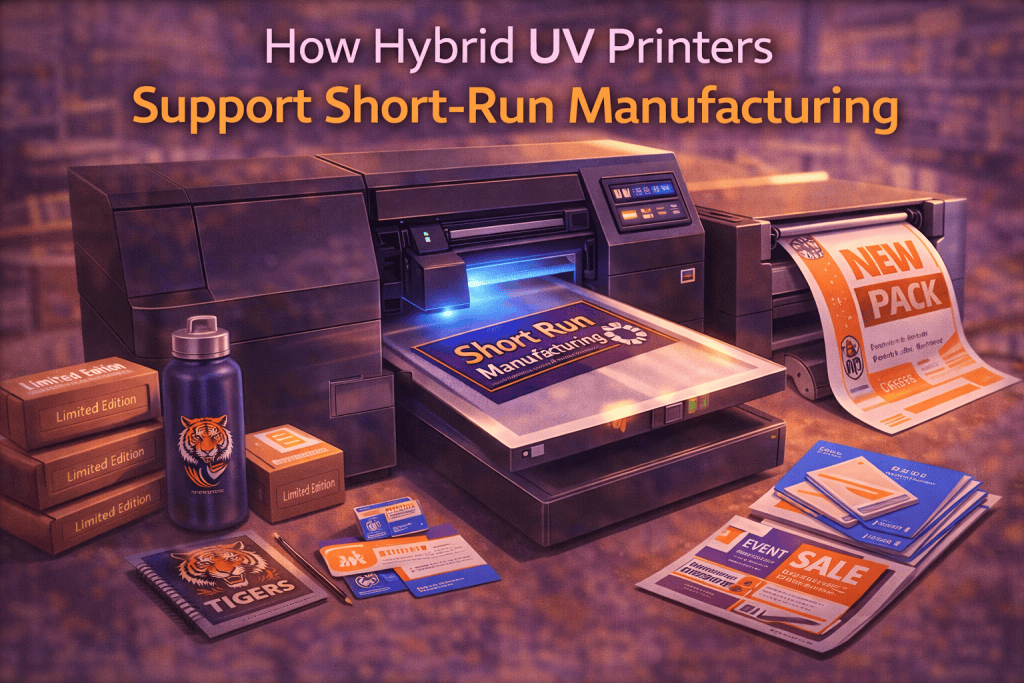
To meet these evolving demands, hybrid UV printers have emerged as a powerful printing solution. By combining the strengths of flatbed and roll-to-roll printing with UV curing technology, hybrid UV printers enable manufacturers to produce high-quality, customized outputs efficiently—even in small batches.
This article explores how hybrid UV printers support short-run manufacturing, their key advantages, features, and real-world applications, and why they are becoming an essential investment for modern production environments.
What Is Hybrid UV Printing?
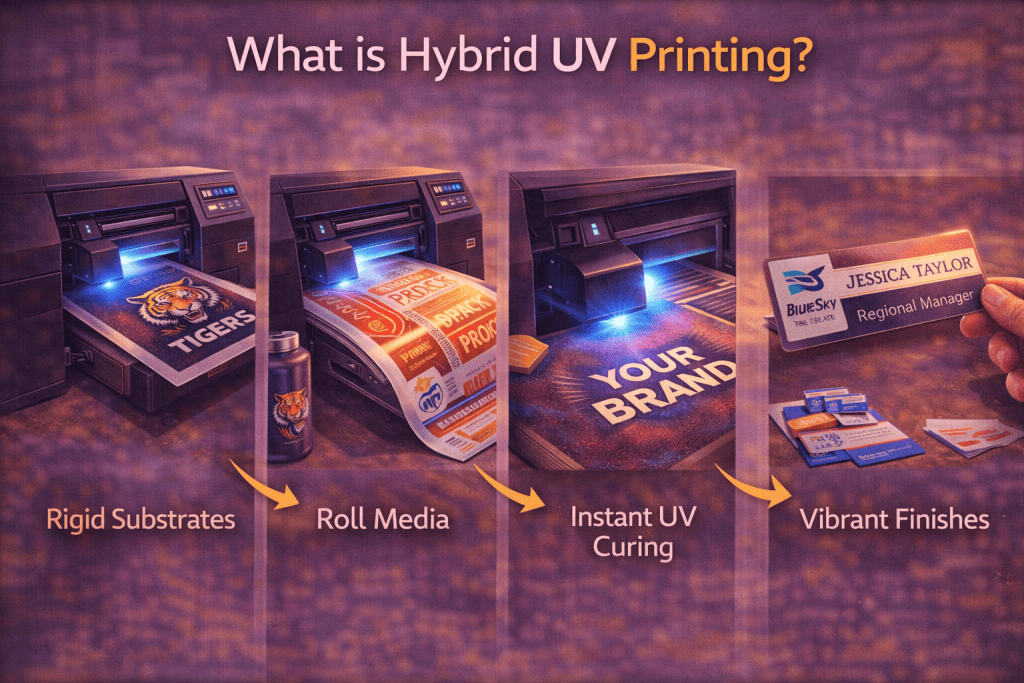
Hybrid UV printing is a digital printing technology that integrates both rigid (flatbed) and flexible (roll media) printing capabilities into a single machine. These printers use UV light to instantly cure inks, allowing prints to dry immediately without absorption into the material.
This technology enables printing on a wide variety of substrates, including:
- Plastic
- Acrylic
- Glass
- Wood
- Metal
- Vinyl and flexible films
Because of this adaptability, hybrid UV printers are exceptionally well-suited for short-run and on-demand manufacturing.
Why Short-Run Manufacturing Needs Hybrid UV Printers
Short-run manufacturing focuses on small batch production, frequent design changes, and rapid delivery. Traditional printing methods often struggle in this area due to long setup times, higher waste, and inflexibility.
Hybrid UV printers address these challenges directly.
Key Benefits of Hybrid UV Printers for Short-Run Manufacturing

1. Material Versatility Without Setup Delays
Hybrid UV printers allow manufacturers to switch seamlessly between rigid and flexible substrates. This means short runs across different product types can be handled on the same machine without time-consuming reconfiguration.
Result: Faster job changes and higher production efficiency.
2. Faster Turnaround Times
UV inks cure instantly, eliminating drying time. Products can be handled, cut, or shipped immediately after printing.
For short-run manufacturing, this enables:
- Same-day production
- Faster order fulfillment
- Quick response to market trends
3. High Print Quality for Limited Editions
Short-run products often demand premium appearance, especially for branding, packaging, and promotional items. Hybrid UV printers deliver:
- Sharp text and fine details
- Smooth gradients
- Rich, consistent colors
This ensures that even small batches meet high professional standards.
4. Reduced Waste and Lower Production Costs
Traditional printing methods often require plates, screens, or extensive setup, which increases waste for small runs. Hybrid UV printing eliminates these requirements.
Cost advantages include:
- Minimal ink waste
- No setup materials
- Fewer rejected prints
This makes short-run production economically viable.
5. Environmentally Responsible Printing
Sustainability is increasingly important in manufacturing. Hybrid UV printing supports eco-friendly goals by:
- Using low-VOC or VOC-free inks
- Reducing material waste
- Eliminating solvent evaporation
This allows manufacturers to align production with modern environmental standards.
Key Features That Make Hybrid UV Printers Ideal for Short Runs
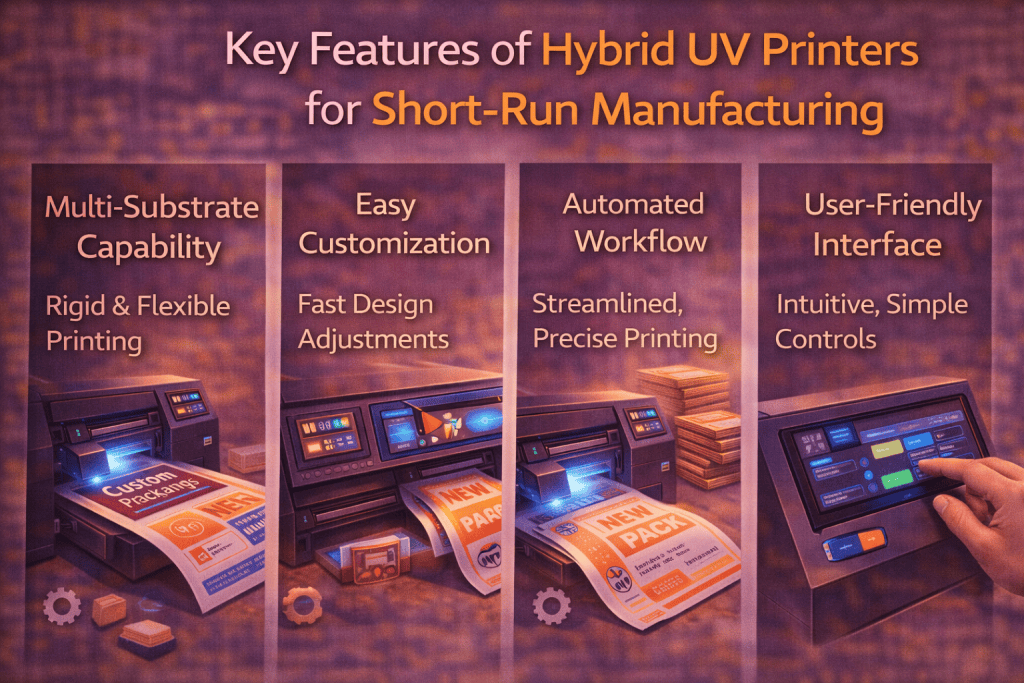
Multi-Substrate Printing Capability
Hybrid UV printers can handle both rigid boards and roll media, enabling diverse short-run applications from a single device.
Easy Customization and Variable Data Printing
Design changes between runs are simple and cost-effective. Manufacturers can personalize each batch without additional setup costs.
Automated Workflow Systems
Modern hybrid UV printers include automation features such as:
- Automatic media alignment
- Color management systems
- Consistent ink control
These features reduce human error and improve repeatability.
User-Friendly Operation
Intuitive interfaces make hybrid UV printers accessible even for operators with minimal technical experience, reducing training time and operational complexity.
High-Speed UV Curing Technology
Instant curing allows faster handling and finishing, a critical requirement for short production cycles.
Real-World Applications of Hybrid UV Printing in Short-Run Manufacturing
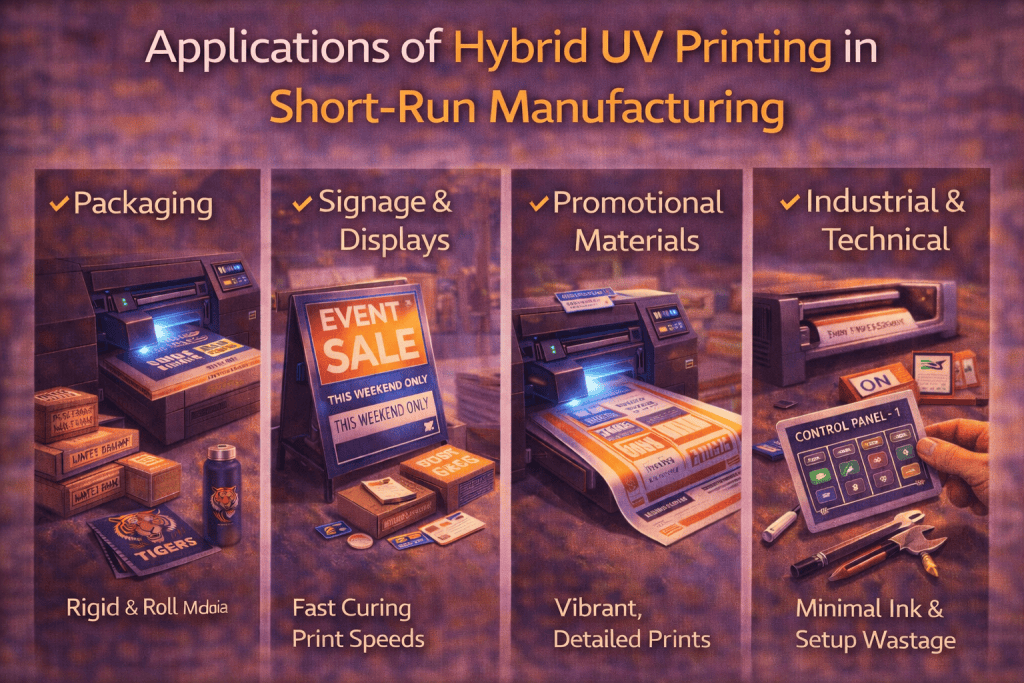
Packaging and Product Branding
Brands use hybrid UV printers to produce limited-edition packaging, prototypes, and short promotional runs without high setup costs.
Signage and Displays
Custom event signage, seasonal promotions, and retail displays benefit from the speed and flexibility of hybrid UV printing.
Promotional Materials
Short-run brochures, display panels, point-of-sale materials, and branded boards can be produced quickly and economically.
Industrial and Technical Applications
Hybrid UV printers are used to create labels, nameplates, overlays, and control panels in small quantities for industrial equipment.
Why Hybrid UV Printing Is a Strategic Investment
For businesses focused on short-run manufacturing, hybrid UV printers offer:
- Faster market response
- Lower operational costs
- Premium product quality
- Increased production flexibility
These advantages help manufacturers stay competitive in markets where customization and speed define success.
Conclusion
Hybrid UV printers have become a cornerstone technology for short-run manufacturing. Their ability to deliver high-quality prints, rapid turnaround, material versatility, and cost efficiency makes them an ideal solution for modern production needs, Explore our high-quality hybrid UV printers here.
As industries continue to move toward customization and on-demand manufacturing, hybrid UV printing provides the flexibility and performance required to scale without sacrificing quality. For businesses looking to future-proof their operations, investing in hybrid UV technology is not just an upgrade—it’s a strategic move.
Frequently Asked Questions (FAQ)
What materials can hybrid UV printers print on?
Hybrid UV printers can print on rigid and flexible materials such as plastic, glass, metal, wood, acrylic, vinyl, and paper.
How is hybrid UV printing different from traditional printing?
Hybrid UV printing uses instant UV curing, allowing faster production, less waste, and broader substrate compatibility compared to traditional methods.
Are hybrid UV printers suitable for small businesses?
Yes, especially for businesses focused on short-run or customized production, as they reduce waste and setup costs.
Can hybrid UV printers handle frequent design changes?
Absolutely. They are ideal for variable data printing and customization without additional setup expenses.
Which industries benefit most from hybrid UV printing?
Packaging, signage, promotional products, décor, and industrial manufacturing all benefit from hybrid UV printing technology.
How This Hybrid UV Printer Topic Helps Buyers Choose the Right Printer
This guide is most useful for buyers researching hybrid uv printer and comparing real production choices before speaking with a supplier. The practical decision is not only the machine name. Buyers also need to understand material compatibility, workflow, operator skill, ink behavior, finishing steps, maintenance, and the type of jobs the printer can produce profitably.
What to Check Before Buying
- Confirm the target products, materials, and daily production volume.
- Ask for sample prints that match real customer work, not only perfect demo pieces.
- Compare ink, media, labor, maintenance, training, and waste before calculating ROI.
- Check service support, spare parts, installation training, and operator documentation.
- Review whether the printer fits your workspace, power, ventilation, and finishing workflow.
Best-Fit Applications
This topic is relevant for custom printing, short-run production, branded product decoration, and businesses that need repeatable output. The best-fit applications usually depend on substrate, artwork detail, color expectations, durability requirements, and order size. A buyer should list the top five products they want to sell, then test those products before scaling production.
| Decision area | Why it matters | What to verify |
|---|---|---|
| Application fit | Prevents buying a machine for the wrong product mix | Test real customer products and materials |
| Workflow | Controls speed, labor, and repeatability | Map artwork, printing, finishing, inspection, and packing |
| Running cost | Protects profit margin | Include ink, media, waste, labor, parts, and downtime |
| Support | Reduces risk after installation | Ask about training, parts, and troubleshooting response |
Buyer FAQ
What keyword should this article help rank for?
The primary keyword target is hybrid uv printer. Supporting terms should include application phrases, troubleshooting phrases, pricing phrases, and comparison phrases related to hybrid uv printer.
Which MTuTech product page should readers visit next?
The strongest next step is the Hybrid uv printer page because it connects the educational topic to a commercial product category.
How can a print shop use this information?
A print shop can use this guide to build a shortlist of applications, estimate job pricing, prepare sample tests, and ask better questions before buying equipment. That makes the article useful for search visitors and for sales conversations.
Recommended MTuTech Resources
Use these related pages to compare equipment choices and continue researching the right production setup.
- Hybrid uv printer – compare machine options, applications, and production fit.
- UV printer – compare machine options, applications, and production fit.
- Single pass printer – compare machine options, applications, and production fit.
- Visual Positioning UV Printer – compare machine options, applications, and production fit.
- Hybrid UV Printer articles – read more guides in this topic cluster.
- MTuTech Blog – browse more UV, DTF, textile, and production workflow resources.
How Hybrid UV Printers Power Short-Run Manufacturing in Modern Industries: Practical Buying Notes
For buyers comparing a hybrid uv printer, the important question is not only whether the machine can print. The stronger question is whether the full workflow can repeat the same result every day with acceptable cost, operator time, and service support. This is where print samples, material testing, and a clear production plan become more useful than a simple feature list.
Use this topic as part of the MTuTech knowledge cluster for hybrid uv printer. It should help a shop owner, production manager, or sourcing team understand where the printer fits, which questions to ask, and which product page to review next.
What to Verify Before Shortlisting a Machine
- Match the printer to the exact products, substrates, and order sizes you plan to sell.
- Request sample prints using real artwork, real materials, and realistic finishing requirements.
- Estimate ink, media, labor, rejected pieces, maintenance, and downtime before judging ROI.
- Check training, spare parts, installation support, software workflow, and after-sales response.
- Review workspace needs such as power, ventilation, curing, pretreatment, and packing flow.
Best Internal Resources
These MTuTech pages are the best next step for readers who want to move from research to machine comparison:
- Hybrid uv printer – compare specifications, applications, and production fit.
- UV printer – compare specifications, applications, and production fit.
- Single pass printer – compare specifications, applications, and production fit.
- MTuTech Blog – browse related UV, DTF, DTG, textile, and production workflow guides.
Quick Decision Table
| Area | Why it matters | Buyer check |
|---|---|---|
| Application fit | Confirms the printer matches the jobs you want to sell | Test the most common products first |
| Production cost | Protects margin on repeat orders | Include ink, media, labor, waste, and maintenance |
| Output quality | Reduces complaints and reprints | Review adhesion, detail, color, wash/durability, and finish |
| Support | Keeps the machine productive after installation | Ask about training, parts, response time, and troubleshooting |
FAQ
Which keyword does this guide support?
This post supports searches around hybrid uv printer together with application, cost, comparison, and troubleshooting queries related to hybrid uv printer.
Which page should readers visit after this article?
The strongest next step is the most relevant MTuTech product page listed above. That gives readers a direct path from education to machine comparison.