


Introduction
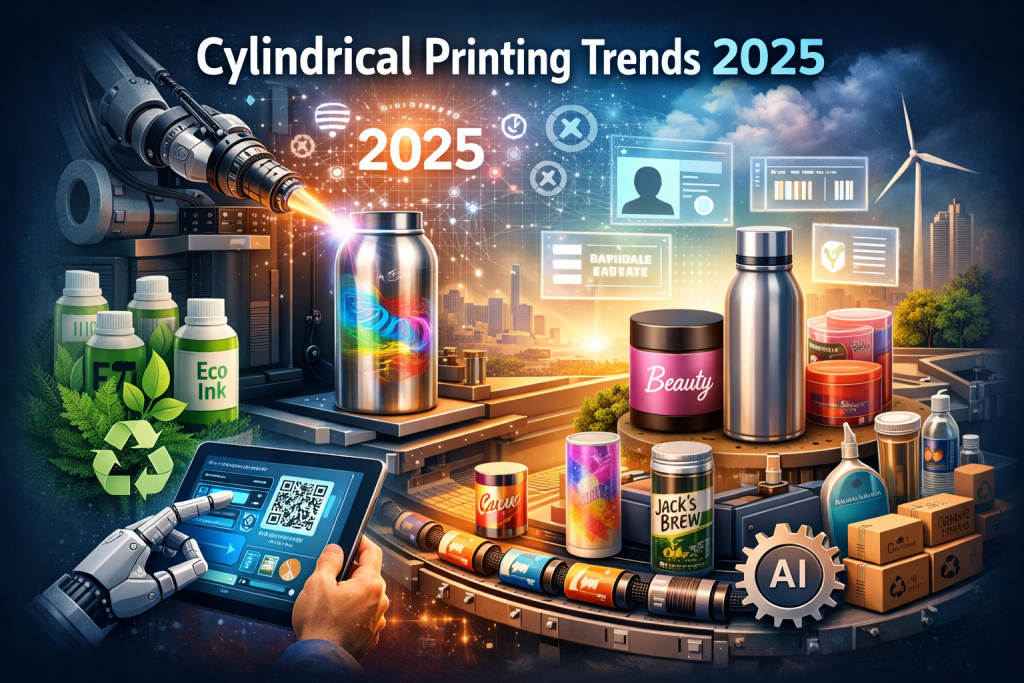
Cylindrical printing has evolved far beyond its original role of applying basic text or graphics onto round objects. In 2025, this printing segment stands at the intersection of advanced digital technology, sustainability, automation, and mass customization. From beverage bottles and cosmetic containers to industrial components and promotional products, cylindrical printing is becoming a critical branding and manufacturing tool.
As competition intensifies across packaging and product industries, brands are demanding faster turnaround times, higher print quality, reduced waste, and the ability to personalize at scale. These demands are driving rapid innovation in cylindrical printing technologies, materials, inks, and workflows.
This article explores the most important cylindrical printing trends shaping 2025, explains why they matter, and highlights how businesses can leverage these developments to stay competitive, cost-efficient, and future-ready.
Evolution of Cylindrical Printing Technology
Cylindrical printing initially relied on traditional methods such as screen printing and offset printing. While effective for large volumes, these techniques lacked flexibility, required lengthy setup times, and offered limited customization.
In recent years, digital cylindrical printing has transformed the industry by introducing:
- Direct-to-object printing
- Faster job changeovers
- High-resolution, full-color output
- Minimal setup requirements
By 2025, these advancements have matured, enabling manufacturers and print service providers to meet modern demands without sacrificing efficiency or quality.
Advanced Digital Direct Printing
Precision Without Printing Plates
One of the strongest trends in cylindrical printing is the widespread adoption of digital direct printing. This method eliminates the need for physical printing plates, allowing designs to be printed directly onto cylindrical objects.
Key improvements seen in 2025 include:
- Ultra-high-resolution print heads delivering sharper text and smoother gradients
- Improved ink adhesion on diverse materials such as glass, plastic, aluminum, and coated metals
- Faster curing processes that reduce production bottlenecks
Digital direct printing enables businesses to switch designs quickly, making it ideal for short runs, seasonal packaging, and frequent brand refreshes.
Cost Efficiency for Short and Medium Runs
Traditional printing methods become expensive when setup costs are spread across small quantities. Digital cylindrical printing solves this problem by offering consistent per-unit pricing regardless of volume.
This cost structure benefits:
- Startups launching new products
- Brands testing limited editions
- Businesses responding to regional or campaign-specific demands
Rise of Eco-Friendly Ink Technologies
Water-Based and Low-VOC Inks
Sustainability is no longer optional in 2025. Governments, retailers, and consumers are demanding cleaner production processes. As a result, eco-friendly inks are becoming standard in cylindrical printing.
Modern water-based and low-VOC inks offer:
- Reduced environmental impact
- Safer handling and indoor usage
- Compliance with international environmental standards
Despite earlier concerns, these inks now match or exceed solvent-based inks in durability, color vibrancy, and resistance to wear.
Improved Ink Performance
Advancements in ink chemistry have addressed historical limitations such as slow drying times and limited substrate compatibility. In 2025, eco-friendly inks are engineered to:
- Cure faster under UV or LED systems
- Bond securely to curved surfaces
- Maintain color stability under heat, moisture, and light exposure
Customization and Personalization at Scale
On-Demand Cylindrical Printing
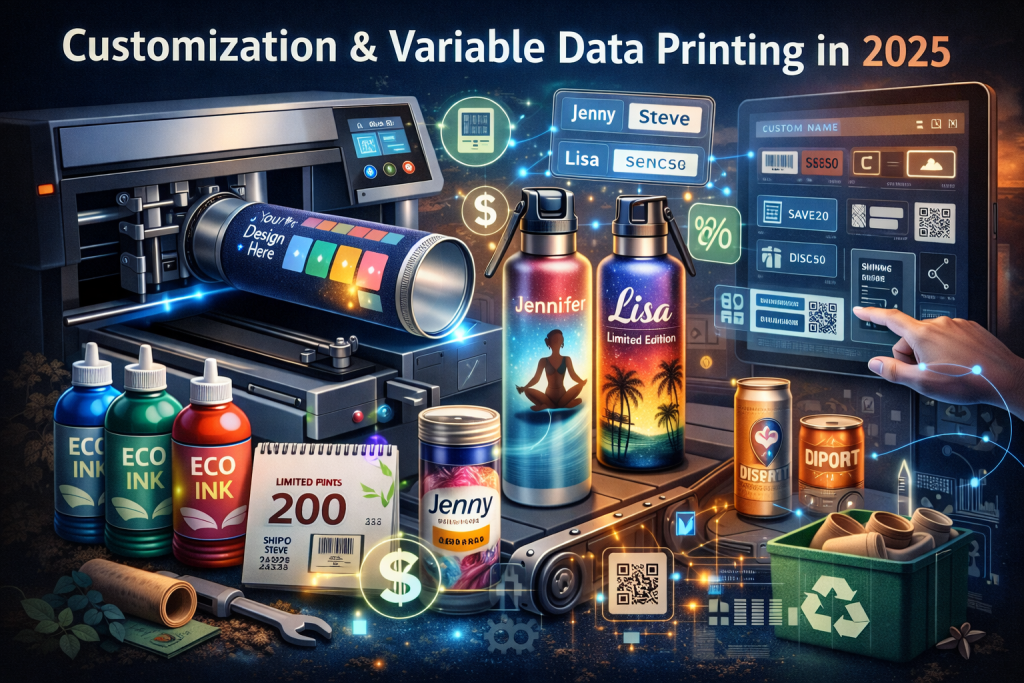
Consumer preferences are shifting toward personalized products, and cylindrical printing is perfectly positioned to meet this demand. On-demand printing allows brands to produce exactly what is needed, when it is needed.
Applications include:
- Personalized beverage bottles
- Custom cosmetic packaging
- Event-specific promotional items
- Regional language or market-specific labels
This approach reduces excess inventory, minimizes storage costs, and increases customer satisfaction.
Variable Data Printing
Variable data printing (VDP) enables each printed item to contain unique information while maintaining production speed. In 2025, this technology is widely used for:
- Serial numbers and QR codes
- Personalized names or messages
- Batch tracking and authentication features
VDP enhances traceability, supports marketing campaigns, and improves consumer engagement without slowing down production.
Automation and Smart Manufacturing

Integration of IoT in Cylindrical Printing
Smart cylindrical printing systems now incorporate Internet of Things (IoT) capabilities that enable real-time monitoring and control.
Key benefits include:
- Remote diagnostics and performance tracking
- Automatic detection of print defects
- Data-driven optimization of print settings
These systems reduce human error and ensure consistent quality across production runs.
Predictive Maintenance
Unplanned downtime can be costly. In 2025, predictive maintenance tools analyze machine performance data to identify potential issues before they cause failures.
This results in:
- Reduced maintenance costs
- Longer equipment lifespan
- Higher overall equipment efficiency
Role of Artificial Intelligence in Workflow Optimization
Although AI operates mostly behind the scenes, its impact on cylindrical printing is significant. AI-driven software assists with:
- Automatic color correction
- Intelligent job scheduling
- Quality inspection through image recognition
These tools help printing businesses improve output quality while reducing labor dependency and material waste.
Sustainable Materials and Substrates

Shift Toward Recyclable and Biodegradable Materials
Sustainability efforts extend beyond inks to include substrates and packaging materials. Cylindrical printing in 2025 increasingly supports:
- Recyclable plastics
- Biodegradable polymers
- Lightweight glass alternatives
Manufacturers are optimizing print adhesion and durability on these materials without compromising eco-credentials.
Carbon Footprint Reduction
Sustainable sourcing, energy-efficient machines, and waste-minimization strategies are helping reduce the overall carbon footprint of cylindrical printing operations.
Waste Reduction and Lean Production Practices
Material Optimization
Modern design software and print planning tools help reduce ink usage and material waste. Precise ink deposition ensures that only the required amount is used for each job.
Recycling and Reuse Programs
Many printing facilities now implement recycling systems for:
- Excess inks
- Misprinted items
- Packaging materials
These initiatives not only reduce environmental impact but also lower operating costs.
Industries Driving Cylindrical Printing Growth
Beverage and Food Packaging
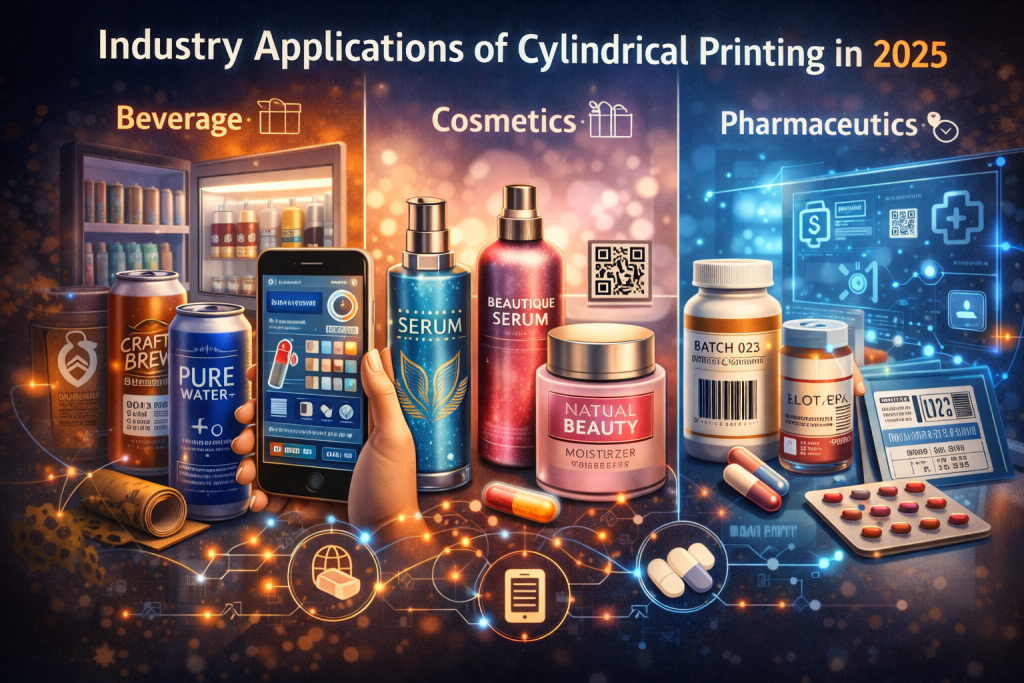
The beverage and food sector remains the largest driver of cylindrical printing demand. In 2025, brands focus heavily on:
- Shelf appeal through high-quality graphics
- Smart labels providing product information
- Compliance with food safety and labeling regulations
Cylindrical printing enables seamless 360-degree branding that attracts consumers and builds trust.
Cosmetics and Personal Care
Cosmetic brands rely on visual differentiation. Cylindrical printing allows:
- Premium finishes on bottles and jars
- Small-batch customization for influencer and campaign launches
- Consistent branding across global markets
Pharmaceuticals and Healthcare
Precision and compliance are critical in healthcare packaging. Cylindrical printing supports:
- Clear dosage instructions
- Batch and expiry tracking
- Anti-counterfeit measures
Expansion Into New Market Segments
Home and Lifestyle Products
Home décor, candles, reusable containers, and lifestyle accessories are adopting cylindrical printing to enhance aesthetics and personalization.
Automotive and Industrial Components
Functional printing on cylindrical parts such as pipes, filters, and components is gaining traction for:
- Branding
- Identification
- Safety markings
Collaborative Innovation and Partnerships
Collaboration between printer manufacturers, material suppliers, and software developers is accelerating innovation. These partnerships are leading to:
- More efficient printing systems
- Improved material compatibility
- Integrated digital workflows
Such collaboration ensures that cylindrical printing continues to evolve in alignment with market needs.
Business Advantages of Adopting Modern Cylindrical Printing
Companies investing in advanced cylindrical printing solutions benefit from:
- Faster time-to-market
- Reduced operational costs
- Greater design flexibility
- Enhanced sustainability credentials
These advantages translate directly into stronger brand positioning and higher customer satisfaction.
Future Outlook Beyond 2025
Looking ahead, cylindrical printing is expected to further integrate with smart packaging, augmented reality labels, and fully automated production lines. Continuous innovation will focus on:
- Zero-waste printing
- Even higher print speeds
- Greater compatibility with emerging materials
Businesses that adapt early will be best positioned to capitalize on these developments.
Conclusion
Cylindrical printing in 2025 represents a powerful blend of technology, creativity, and sustainability. From digital direct printing and eco-friendly inks to automation and personalization, the industry is redefining how products are branded and manufactured, explore our high-quality cylindrical printers here to take advantage of these trends and make your mark in the industry.
As market expectations continue to rise, adopting modern cylindrical printing solutions is no longer a luxury—it is a strategic necessity. Companies that embrace these trends will not only enhance print quality and efficiency but also align with global sustainability goals and evolving consumer preferences.
Frequently Asked Questions
What is cylindrical printing?
Cylindrical printing is a printing method used to apply text, graphics, and designs directly onto round or curved surfaces such as bottles, cans, tubes, and jars.
Why is digital cylindrical printing growing in popularity?
Digital cylindrical printing offers high quality, fast turnaround, cost efficiency for short runs, and easy customization without the need for printing plates.
How does sustainability impact cylindrical printing?
Sustainability influences the use of eco-friendly inks, recyclable materials, energy-efficient machines, and waste reduction practices across the printing process.
Which industries benefit most from cylindrical printing?
Key industries include beverages, food packaging, cosmetics, personal care, pharmaceuticals, home décor, and industrial manufacturing.
What trends should businesses focus on in 2025?
Businesses should focus on automation, personalization, eco-friendly materials, smart printing systems, and data-driven production workflows.
How This Cylindrical Printer Topic Helps Buyers Choose the Right Printer
This guide is most useful for buyers researching cylindrical printer and comparing real production choices before speaking with a supplier. The practical decision is not only the machine name. Buyers also need to understand material compatibility, workflow, operator skill, ink behavior, finishing steps, maintenance, and the type of jobs the printer can produce profitably.
What to Check Before Buying
- Confirm the target products, materials, and daily production volume.
- Ask for sample prints that match real customer work, not only perfect demo pieces.
- Compare ink, media, labor, maintenance, training, and waste before calculating ROI.
- Check service support, spare parts, installation training, and operator documentation.
- Review whether the printer fits your workspace, power, ventilation, and finishing workflow.
Best-Fit Applications
This topic is relevant for custom printing, short-run production, branded product decoration, and businesses that need repeatable output. The best-fit applications usually depend on substrate, artwork detail, color expectations, durability requirements, and order size. A buyer should list the top five products they want to sell, then test those products before scaling production.
| Decision area | Why it matters | What to verify |
|---|---|---|
| Application fit | Prevents buying a machine for the wrong product mix | Test real customer products and materials |
| Workflow | Controls speed, labor, and repeatability | Map artwork, printing, finishing, inspection, and packing |
| Running cost | Protects profit margin | Include ink, media, waste, labor, parts, and downtime |
| Support | Reduces risk after installation | Ask about training, parts, and troubleshooting response |
Buyer FAQ
What keyword should this article help rank for?
The primary keyword target is cylindrical printer. Supporting terms should include application phrases, troubleshooting phrases, pricing phrases, and comparison phrases related to cylindrical printer.
Which MTuTech product page should readers visit next?
The strongest next step is the Cylindrical Printer page because it connects the educational topic to a commercial product category.
How can a print shop use this information?
A print shop can use this guide to build a shortlist of applications, estimate job pricing, prepare sample tests, and ask better questions before buying equipment. That makes the article useful for search visitors and for sales conversations.
Recommended MTuTech Resources
Use these related pages to compare equipment choices and continue researching the right production setup.
- Cylindrical Printer – compare machine options, applications, and production fit.
- Cylinder Uv printer – compare machine options, applications, and production fit.
- 360 rotary uv printer – compare machine options, applications, and production fit.
- UV printer – compare machine options, applications, and production fit.
- Cylindrical Printer articles – read more guides in this topic cluster.
- MTuTech Blog – browse more UV, DTF, textile, and production workflow resources.