


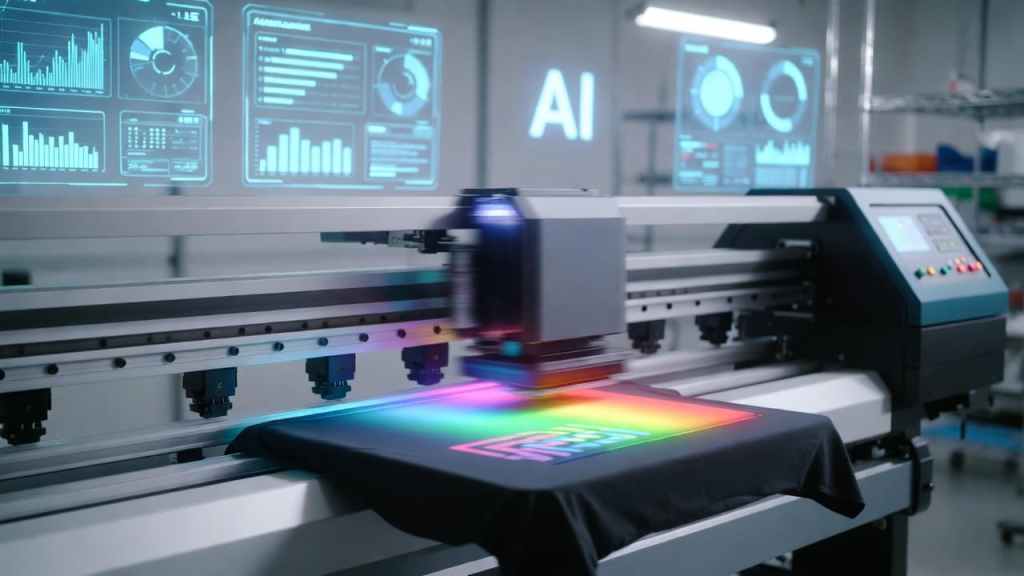
Direct-to-Garment (DTG) printing has already revolutionized the custom apparel market by enabling high-resolution, full-color designs to be printed directly onto fabric with remarkable detail. Unlike traditional screen printing, DTG allows businesses to produce small batches, personalized garments, and on-demand orders without complex setup processes.
Now, a second transformation is underway. Artificial Intelligence (AI) and automation are reshaping how DTG businesses design, produce, manage, and scale their operations. These technologies are not just enhancing productivity—they are redefining what is possible in customization, speed, and profitability.
From intelligent design assistance and predictive production planning to automated workflows and real-time quality monitoring, AI-driven DTG environments are becoming smarter, faster, and more efficient. This article explores how these innovations are changing the DTG landscape, the advantages they offer, the challenges businesses must navigate, and what the future holds.
Understanding the Evolution of DTG Printing
DTG printing began as a solution for short-run, high-detail printing needs. It enabled businesses to move away from inventory-heavy production models toward print-on-demand manufacturing. However, early DTG systems still relied heavily on manual preparation, operator experience, and reactive decision-making.
Today’s market demands:
- Faster turnaround times
- Greater personalization
- Consistent color accuracy
- Lower operational waste
- Scalable production without sacrificing quality
AI and automation address these demands by replacing guesswork with data-driven intelligence and replacing repetitive manual tasks with precise, repeatable systems.
The Role of Artificial Intelligence in DTG Printing

AI introduces decision-making capability into the production process. Instead of simply executing commands, AI-enabled systems analyze patterns, learn from outcomes, and continuously improve performance.
1. Intelligent Design Assistance
Design is one of the most time-consuming stages in custom apparel production. AI-powered tools now assist designers by:
- Generating artwork variations based on prompts or brand style
- Suggesting layouts optimized for garment size and placement
- Recommending color combinations based on trend data
- Automatically adjusting resolution and print parameters
This allows businesses to handle more orders without expanding their design teams.
2. Automated Artwork Optimization
Preparing files for DTG printing traditionally required manual adjustments for:
- Color profiling
- Ink density
- Fabric compatibility
- Print resolution
AI software can now analyze artwork and automatically optimize it for the chosen garment, ensuring better print quality while reducing setup time.
3. Predictive Demand Forecasting
AI excels at analyzing historical data and identifying trends. DTG businesses can use this capability to:
- Forecast seasonal demand
- Identify popular design categories
- Adjust production capacity ahead of peak periods
- Reduce overproduction and unsold inventory
This predictive approach helps transform DTG from reactive manufacturing to strategic production planning.
4. Smart Production Scheduling
AI-driven scheduling systems dynamically allocate resources based on:
- Order urgency
- Machine availability
- Garment types
- Estimated print duration
This results in smoother workflows and fewer production bottlenecks.
Automation’s Impact on DTG Production Efficiency

While AI focuses on intelligence and analysis, automation handles execution. Together, they create a seamless production ecosystem.
1. End-to-End Workflow Automation
Modern DTG facilities increasingly automate the entire process:
- Online order received
- Artwork automatically validated
- File routed to RIP software
- Printer settings configured automatically
- Garment pre-treatment applied via automated systems
- Printing completed with minimal operator intervention
- Curing, packing, and shipping triggered automatically
This reduces manual touchpoints and accelerates turnaround times dramatically.
2. Reduced Human Error
Manual handling can introduce inconsistencies such as misalignment, incorrect settings, or color variations. Automation ensures:
- Precise garment positioning
- Consistent ink application
- Repeatable production quality
- Fewer rejected prints
Consistency builds customer trust and reduces costly reprints.
3. Faster Order Fulfillment
Automation enables true on-demand production. Businesses can process hundreds of unique designs daily without slowing down, making it ideal for:
- E-commerce apparel brands
- Personalized merchandise providers
- Event-driven printing campaigns
4. Lower Operational Costs
Although automation requires initial investment, it reduces long-term expenses by:
- Minimizing labor-intensive processes
- Reducing ink and material waste
- Increasing throughput per machine
- Lowering error-related losses
The Power of Combining AI and Automation
The real transformation happens when AI insights drive automated systems.
Adaptive Printing Environments
AI can analyze fabric type, humidity, artwork complexity, and production speed to instruct machines to adjust:
- Ink volume
- Print head movement
- Curing temperature
- Pre-treatment levels
This creates a responsive printing environment that adapts in real time rather than relying on static presets.
Hyper-Personalization at Scale
AI enables businesses to offer mass customization without slowing production. Customers can personalize:
- Names and numbers
- Unique graphics
- Color variations
- Limited-edition artwork
Automation then ensures each item is produced efficiently, even when every order is different.
Continuous Performance Improvement
AI systems monitor production metrics such as:
- Print accuracy
- Machine utilization
- Downtime frequency
- Material consumption
They then recommend adjustments that improve efficiency over time.
Enhancing Quality Control Through Smart Technology
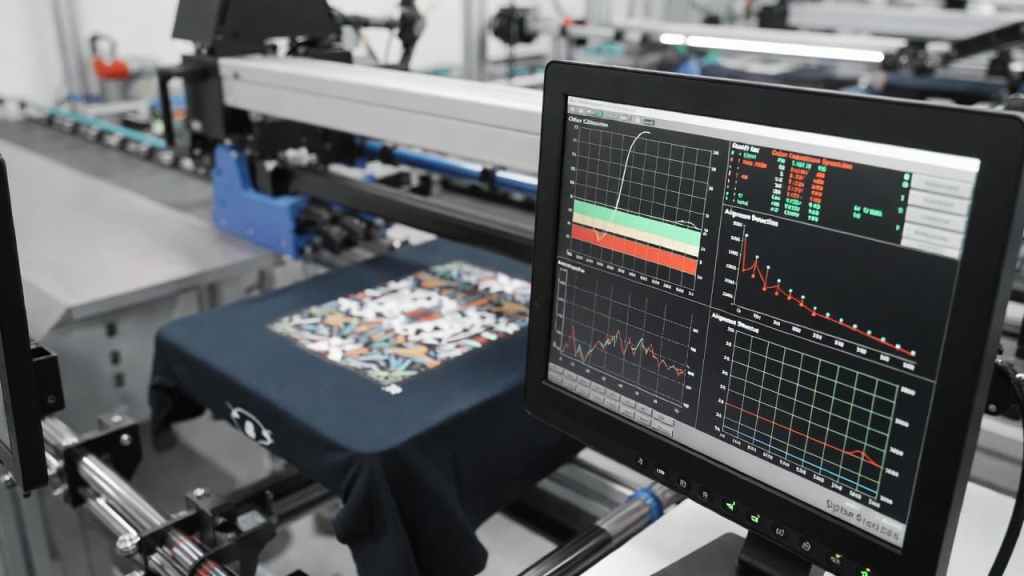
Quality control is essential in DTG printing, where even minor inconsistencies can affect the final product.
Automated Inspection Systems
Modern DTG workflows incorporate visual monitoring tools that detect:
- Misprints
- Color deviations
- Alignment issues
- Ink distribution problems
These systems flag errors instantly, allowing corrections before orders ship.
Data-Driven Color Management
AI-assisted color calibration ensures that prints remain consistent across:
- Different machines
- Production batches
- Fabric types
- Environmental conditions
This level of consistency was difficult to maintain using manual calibration alone.
Sustainability Benefits of AI-Driven DTG Printing
Sustainability is becoming a major priority for apparel businesses, and AI-powered DTG production supports environmentally responsible practices.
Reduced Material Waste
AI optimizes print layouts and ink usage, ensuring only necessary resources are consumed.
On-Demand Manufacturing
Automation supports a print-on-demand model, which eliminates:
- Excess inventory
- Unsold garments
- Storage waste
Energy Efficiency
Smart production scheduling reduces idle machine time, lowering overall energy consumption.
Challenges Businesses Must Consider
Despite the benefits, adopting AI and automation requires careful planning.
1. Initial Investment
Upgrading to intelligent systems involves costs related to:
- Equipment upgrades
- Software integration
- Workflow redesign
However, businesses often recover these costs through increased efficiency and scalability.
2. Workforce Transition
Employees must shift from manual production roles to technology-driven responsibilities such as:
- System monitoring
- Workflow management
- Data analysis
- Equipment optimization
Training is essential to ensure a smooth transition.
3. Data Management and Security
AI relies heavily on data. Businesses must implement safeguards to protect:
- Customer information
- Design files
- Operational analytics
Strong cybersecurity policies are now part of modern print operations.
Practical Steps to Implement AI and Automation in DTG
Businesses looking to modernize their DTG workflow can follow a phased approach.
Step 1: Evaluate Current Workflow
Identify bottlenecks, repetitive tasks, and areas prone to errors.
Step 2: Introduce Automation Gradually
Start with:
- Automated pre-treatment systems
- Workflow management software
- Smart RIP solutions
Step 3: Integrate Data Analytics
Use AI tools to monitor production trends and improve forecasting accuracy.
Step 4: Train Teams for Digital Operations
Focus on building technical confidence among staff rather than replacing human expertise.
Step 5: Scale Based on Insights
Once systems are optimized, expand automation across the production chain.
Key Metrics to Measure Success
To evaluate the impact of AI and automation, DTG businesses should track:
- Production speed per garment
- Error and reprint rates
- Ink consumption efficiency
- Order turnaround time
- Labor cost per unit
- Customer satisfaction levels
These metrics reveal measurable improvements and guide future investment decisions.
The Competitive Advantage of Smart DTG Operations
Businesses that embrace AI-driven DTG printing gain several strategic advantages:
- Faster response to market trends
- Ability to handle high customization demand
- Improved consistency across large order volumes
- Better resource management
- Scalability without proportional cost increases
In a competitive apparel market, speed and personalization are critical differentiators—and AI enables both.
Future Trends in AI-Powered DTG Printing

The integration of AI and automation is still evolving. Over the next decade, we can expect:
Fully Autonomous Production Lines
DTG systems will increasingly operate with minimal human intervention, from order intake to shipping.
Smarter Personalization Engines
AI will generate custom design suggestions tailored to individual customers in real time.
Cloud-Connected Print Networks
Multiple printers across locations will share data, enabling distributed production models.
Advanced Fabric Recognition
Systems will automatically detect textile composition and adjust print parameters instantly.
Predictive Maintenance
AI will anticipate machine servicing needs before failures occur, reducing downtime.
Why Human Creativity Still Matters
Despite technological advances, DTG printing remains a creative industry. AI enhances human capability rather than replacing it.
Designers still define brand identity. Operators still oversee quality. Business owners still shape strategy. AI simply removes inefficiencies so teams can focus on innovation and growth.
The most successful DTG businesses will be those that combine human creativity with machine intelligence.
Conclusion
AI and automation are not just upgrades to DTG printing—they represent a shift toward smarter, more adaptive manufacturing. By improving design workflows, optimizing production, ensuring consistent quality, and enabling scalable customization, these technologies are transforming how apparel is created and delivered.
Businesses that adopt intelligent DTG solutions position themselves for faster growth, reduced waste, and stronger competitiveness in an increasingly on-demand marketplace. As innovation continues, AI-driven DTG printing will become the standard rather than the exception.explore our high-quality DTG printers here
The future of garment printing is not only digital—it is intelligent, automated, and deeply customer-focused.
FAQ
What is DTG printing?
DTG (Direct-to-Garment) printing is a digital printing method that applies water-based inks directly onto fabric, allowing for detailed, full-color designs without the need for screens.
How does AI improve DTG production?
AI enhances DTG by automating design optimization, predicting demand, improving workflow efficiency, and ensuring consistent print quality through data-driven adjustments.
What are the main benefits of automation in DTG printing?
Automation increases speed, reduces errors, lowers labor costs, ensures repeatable quality, and enables efficient on-demand manufacturing.
Is AI-based DTG printing suitable for small businesses?
Yes. Scalable solutions allow small businesses to start with partial automation and expand as order volume grows.
Does automation replace human workers in DTG printing?
No. Automation shifts human roles toward creative, technical, and strategic tasks rather than repetitive manual labor.
What does the future look like for DTG technology?
The future includes smarter machines, real-time customization, predictive maintenance, and fully connected production environments powered by AI.
Recommended MTuTech Resources
Use these related pages to compare equipment choices and continue researching the right production setup.
- DTG Printer – compare machine options, applications, and production fit.
- DTF Printer – compare machine options, applications, and production fit.
- Direct to fabric printer – compare machine options, applications, and production fit.
- Dye sublimation printer – compare machine options, applications, and production fit.
- DTG Printer articles – read more guides in this topic cluster.
- MTuTech Blog – browse more UV, DTF, textile, and production workflow resources.